It Starts Here

Editing Frank Gehry

and Honoring Anne d’Harnoncourt

This winter I had the pleasure of shaping in print a conversation between master architect Frank Gehry and Philadelphia Museum of Art Director Sasha Suda. The interview, conducted shortly after Suda arrived from her previous post at the helm of the National Gallery of Canada, focused on Gehry’s transformation of the museum‘s iconic temple—from the inside, and the bottom up.

That interview is the centerpiece of a recent book project I edited and managed that celebrates the culmination of the Art Museum’s capital campaign “It Starts Here.” Unabridged, the conversation was deep and wide-ranging, and editing it meant trashing many delightful details* and outstanding anecdotes that made for a deeply rich and even personal exchange between these two cultural titans—and true Canadian treasures.**

I thought a lot about beloved PMA director Anne d’Harnoncourt (1943–2008)*** and how to make her proud of the book we were making, of the words we were parsing. Inviting Gehry to work his magic on the bowels of the building was—of course—her idea.
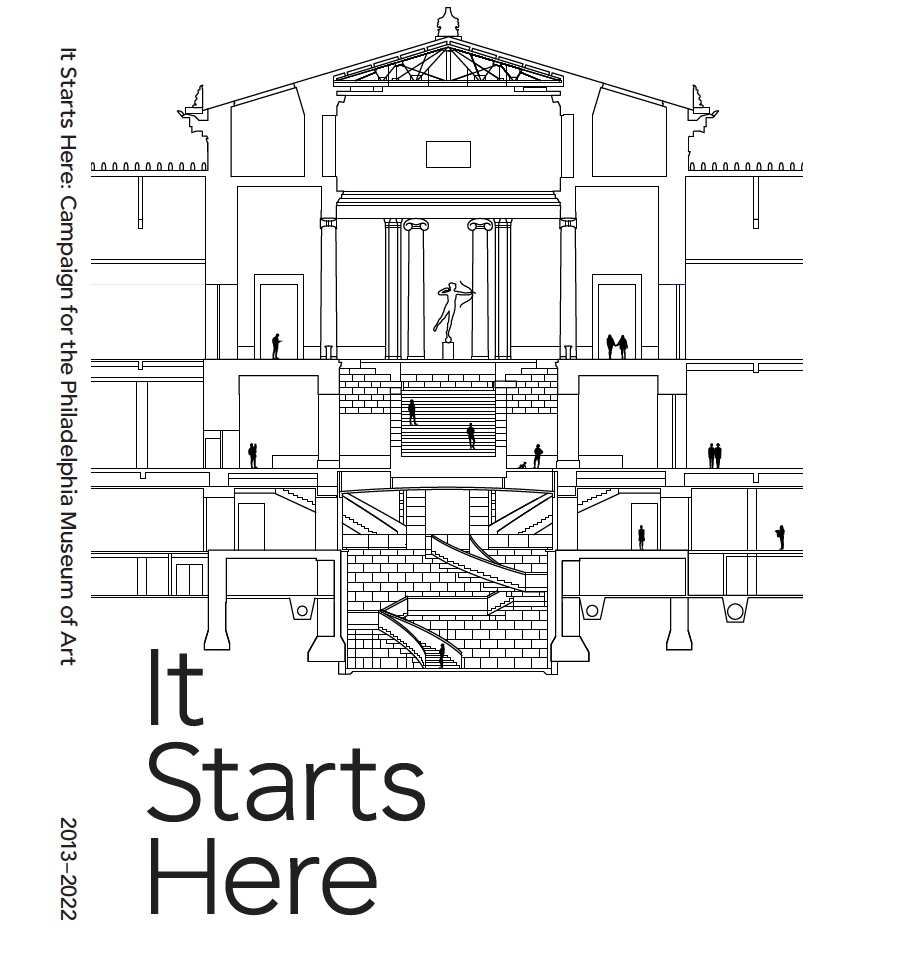
The book also features an illustrated timeline and an essay on the history of the building lovingly contributed by illustrious architectural historian and Penn professor David Brownlee. It’s an editor’s dream to have a scholar of David’s pedigree available as I fact-checked the many minutia that Gehry lovingly recounted to Suda about the history of the museum, its original architects, their competing visions, and the many teams charged with its design and evolution over the decades.

When I took my daughter to Fairmount last weekend, I was proud to say as we passed by the Rocky Steps, “That’s where I worked when I first came to Philadelphia.” I’m honored to have played a small role in how the Art Museum is redefining and reinventing itself now, some three decades years later. A lifetime later, but a blink in Art Museum time.

The image that accompanied AdH’s obituary in the Inquirer, capturing one of what I can only imagine was one of hundreds of conversations she had with President Bob Montgomery Scott at the terrace at the top of the museum steps. If only she’d lived to see the glory that Gehry uncovered in the spaces just below where she spent those 10,000 hours.

* At one point Kathleen Krattenmaker, the Museum’s Head of Publishing, and I both admitted to having a lump in our throat when we saw in the transcript Gehry refer to the former director as “Annie.” Editorial minds prevailed, and we agreed to omit that little gem—proving you really are “Murdering all your darlings” when you edit. (I first heard that expression from Prof. David Price, my thesis advisor and first good, cutthroat editor.)

** Fun facts: At 38, Suda was the youngest director of the National Gallery in Ontario, where she was a proud member of the union. She has a dog named Phil Collins.

*** D’Harnoncourt set an exceptionally high bar in her tenure, not just in terms of her leadership and vision but also integrity and (obviously) taste. She was always the best editor in any room and managed to improve every draft I ever sent her in the 7 years I was worked there—boldly marking comments with her distinctive flourish with a royal blue fountain pen or blood red felt-tip. (Her mark-ups are yet another reason I’m grateful to have lived and worked in an analog age.) Little did I realize how good I had it working my first real job in her orbit from age 21 to 28. I’ve not quite encountered anyone of her caliber since.
A Plan for Action to Improve Philadelphia’s Housing

In fall 2018 I partnered with SAYGRID LLC and Local Initiatives Support Corporation (LISC) Philadelphia to create a Housing Action Plan for the City of Philadelphia’s Department of Housing and Development. This 20-page document outlines the City’s ambitious goals for making housing equitable and affordable in the coming decades—especially for those residents living in units with housing tax credits that are due to expire soon. We worked closely with the city as well as LISC to craft a document that was accessible and readable as well as detailed and informative.Housing-Action-Plan-Final-for-Web cover

How to Jumpstart a community

In 2017, I partnered with Andee Mazzocco of SAYGRID Design to develop a suite of materials for the Jumpstart model of community development. Created by Ken Weinstein of Philly Office Retail, Jumpstart helps local aspiring developers to create equity and keep wealth local while improving blighted properties. The program provides training, mentoring, and networking opportunities, as well as financing options that new developers might not always have. It’s already had a significant impact on the Germantown section of Philadelphia, and is now expanding to Kensington and Mt. Airy. The Barra Foundation provided support to translate Ken’s materials so that neighborhoods in other cities and towns across the U.S. could leverage this same approach. Philadelphia LISC was an essential partner in how to showcase the best of Jumpstart.

In 9 months, our team created a marketing brochure, a 60-page training workbook, a PowerPoint slide deck, a 30-page “How-to” guide for neighborhoods, and a website. I managed the project and developed all the content, in close consultation with Ken and his team. Beautiful photography was done by Steve Legato. Site development by Steven Mangione Web Services. You’re sure to read more about Jumpstart in the coming months.Jumpstart thumbnail


Buy-in for a Green City’s “Clean Waters”

This summer marked the five-year anniversary of the Philadelphia Water Department’s nationally recognized “Green City, Clean Waters” program devoted to green infrastructure for stormwater management. The program, created in service of the city’s long-term sustainability plan, was branded by students at University of the Arts with the slogan, “Soak it up, Philly!”

green-city-panel-1Early in the initiative I provided interpretive planning and developed narratives for signage at various construction sites around the city. The goal was to advise residents about the greening efforts PWD was undertaking above ground—and the green engineering below ground. I integrated research from sites throughout northeast Philadelphia to develop content approaches and partnered with Philadelphia design firm Cloud Gehshan Associates. The signs were featured alongside a rain garden demonstration at 2014’s Philadelphia Flower Show.

In 2015 I also helped the Community Design Collaborative create a how-to guide for schools in Philadelphia that want to redo their schoolyards to make use of green design and maximize benefits for students, developmentally and physically.

collaborative-schoolyards-guide-cover

This was the first in a series of guides for the Collaborative, and I look forward to more collaborations with them. (If you’re interested in all the good work they do, check out pages from the 125-page anniversary publication I created with them in 2011).

20th-anniv_2011_leverage_book_cover-394x340

Save

The trajectory of a research university

Rowan University has undergone a number of exciting changes in the past 18 months. First, it became New Jersey’s newest comprehensive public research university (joined only by Rutgers). Second, it merged with the School of Osteopathic Medicine in Stratford, NJ, to offer an even more broad-based educational program with expanded research and clinical opportunities for students.

FY13AnnualReport FNL cover

To capture the university’s multifaceted talents and initiatives behind these changes, Rowan needed to devise a unique annual report—one that highlighted advances and successes from the previous year, but also branded the diverse research program in light of these developments. Rowan brought in ARC to devise an effective print strategy to integrate the growing South Jersey Technical Park, located on the edge of its Glassboro campus.

Alison conducted interviews with the Associate Provost for Research, who also directs the SJTP, and worked closely with the marketing staff to establish a structure for the publication, but also a voice. I conducted in-depth interviews with high-level administrators—including Dr. Kenneth Blank, who joined Rowan from Temple, in the new position of Vice President for Health Sciences—to integrate into the report the broad, innovative vision for the university in this area.

Continue reading “The trajectory of a research university”

Profiling a Young Filmmaker

I was fortunate to have the chance to interview Bryn Mawr alumna Rehema Trimiew about her 2010 documentary Learning to Fly (watch it online) for her College Alumnae Bulletin. She spent four months in Zambia, filming a group of inspiring, determined young girls who are orphans and encouraging them to tell their stories and make films of their own, on cameras and computers Rehema had donated. Along the way she also learned an array of valuable lessons about the realities of on-the-ground filmmaking, as well as the resilience and creativity this work requires. She has since written a book about the process of making the film, which includes material from her MFA thesis.

I wish Rehema success with her future film projects, and look forward to following her promising career.

Gaining Leverage

I spent much of 2011 helping the Community Design Collaborative to create a book in celebration of the organization’s 20th anniversary. The result is LEVERAGE: Strengthening Neighborhoods though Design, published in September and now available at the AIA Bookstore in Philly (1218 Arch St.) as well as through Distributed Art Publishers and Amazon.com.

LEVERAGE showcases 20 projects that reflect the strong work the Collaborative has done over the past two decades to help neighborhoods and organizations transform themselves in three dimensions, through planning and design services that are entirely pro bono. A series of essays offer national and local perspectives on the impact the organization has made through this good work.

The talented folks at Smyrski Creative designed the book (and check out what they’re doing at the PMA through April 22, in association with the Zoe Strauss show).

Continue reading “Gaining Leverage”

The Hard Work of Being Doggedly Creative

The Pennsylvania Academy of the Fine Arts (PAFA) has been a client for several years, and whenever I’m there I swoon over the collection but also find myself envying the arts students who are talented and passionate enough to attend this prestigious art school.

I just finished work on a brochure about one of PAFA’s most unique programs: the Post Baccalaureate, which provides an intensive year with four dedicated faculty members. The testimonials speak to what it means to come to a place like PAFA to devote one’s self to the hard work of being doggedly creative. And also how transformative even one year can be. I, for one, was inspired.

Exhibition for Penn Presbyterian Cardiology

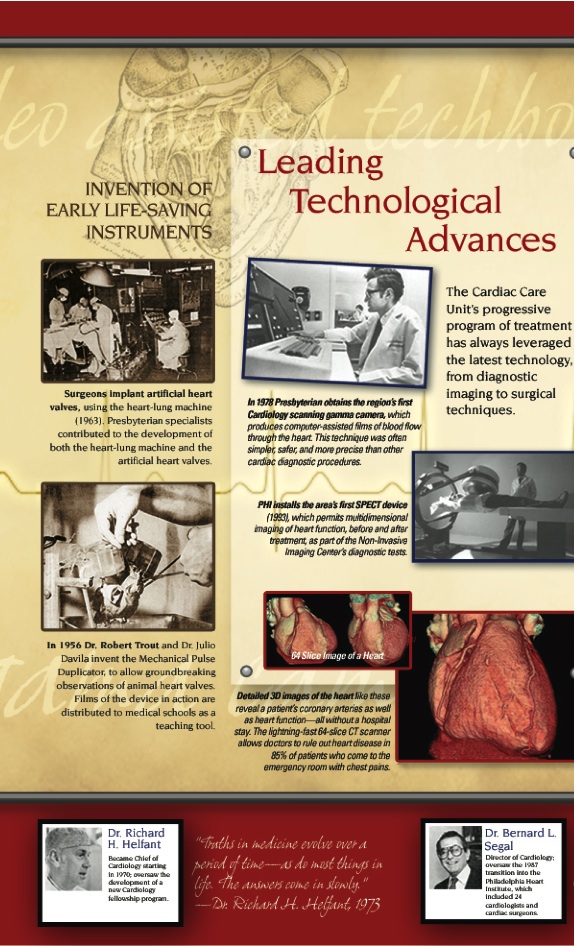
The prestigious Cardiac Program of Penn Presbyterian Hospital in Philadelphia wanted to take advantage of a wall in the lobby of its new building to showcase the pioneering achievements and technological advances that were unique to the hospital. Alison started from scratch by reviewing historic documents and photography at the University of Pennsylvania Archives and devised an interpretive approach based on the strengths and highlights of this archival collection. Interpretive scripting and layout followed, to play up the research, clinical, as well as educational aspects of this cutting-edge program.Penn Presby Cardio Wall 4

Designed by Larry Williams at Backe Communications.

Save